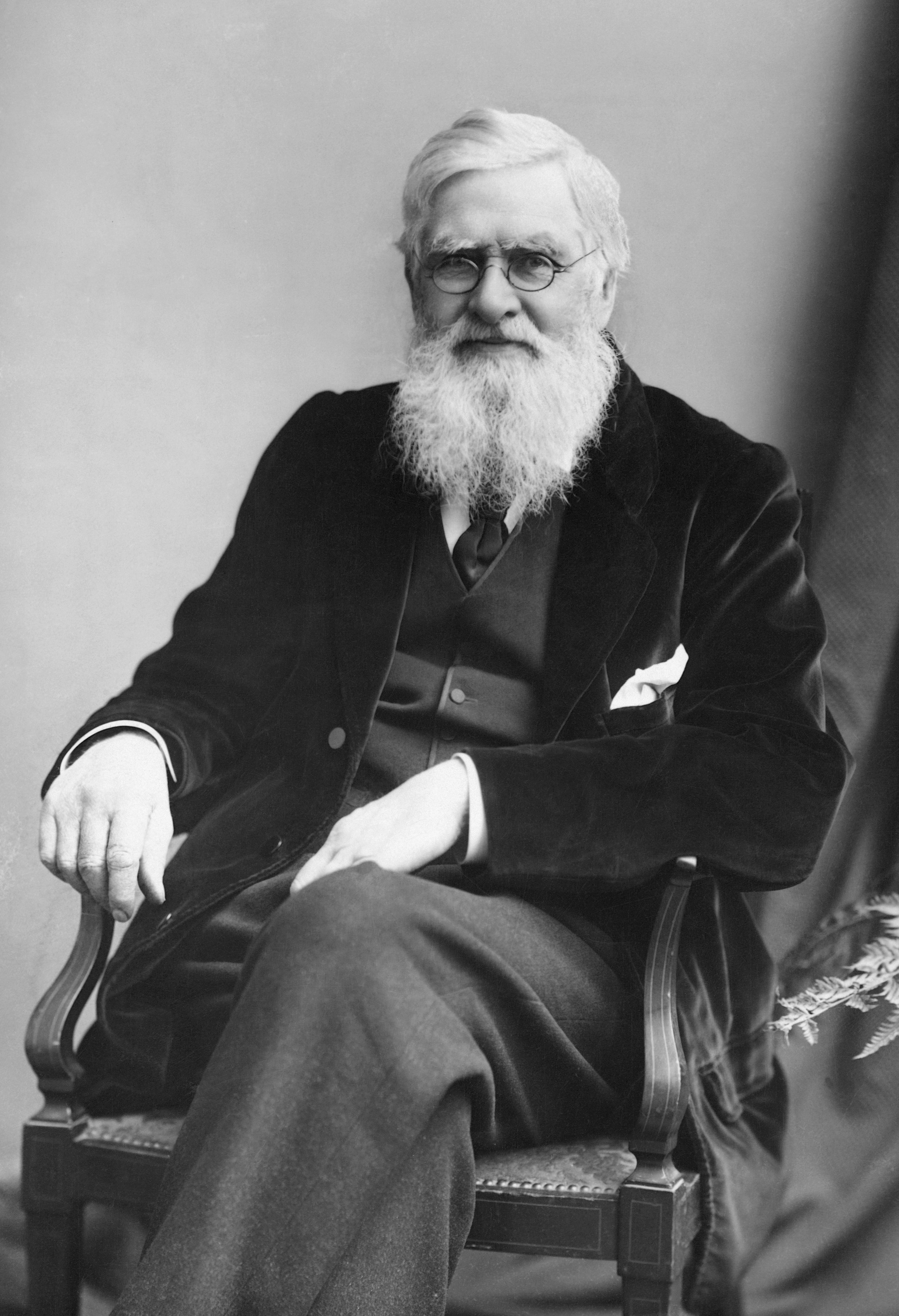
Wallace, Alfred Russel
Alfred Russel Wallace (8 January 1823 – 7 November 1913) was an English naturalist, explorer, geographer, anthropologist, biologist and illustrator. H...
Alfred Russel Wallace (8 January 1823 – 7 November 1913) was an English naturalist, explorer, geographer, anthropologist, biologist and illustrator. He independently conceived the theory of evolution through natural selection; his 1858 paper on the subject was published that year alongside extracts from Charles Darwin's earlier writings on the topic. It spurred Darwin to set aside the "big species book" he was drafting and to quickly write an abstract of it, which was published in 1859 as On the Origin of Species.
Wallace did extensive fieldwork, starting in the Amazon River basin. He then did fieldwork in the Malay Archipelago, where he identified the faunal divide now termed the Wallace Line, which separates the Indonesian archipelago into two distinct parts: a western portion in which the animals are largely of Asian origin, and an eastern portion where the fauna reflect Australasia. He was considered the 19th century's leading expert on the geographical distribution of animal species, and is sometimes called the "father of biogeography", or more specifically of zoogeography.
Wallace was one of the leading evolutionary thinkers of the 19th century, working on warning coloration in animals and reinforcement (sometimes known as the Wallace effect), a way that natural selection could contribute to speciation by encouraging the development of barriers against hybridisation. Wallace's 1904 book Man's Place in the Universe was the first serious attempt by a biologist to evaluate the likelihood of life on other planets. He was one of the first scientists to write a serious exploration of whether there was life on Mars.
Aside from scientific work, he was a social activist, critical of what he considered to be an unjust social and economic system in 19th-century Britain. His advocacy of spiritualism and his belief in a non-material origin for the higher mental faculties of humans strained his relationship with other scientists. He was one of the first prominent scientists to raise concerns over the environmental impact of human activity. He wrote prolifically on both scientific and social issues; his account of his adventures and observations during his explorations in Southeast Asia, The Malay Archipelago, was first published in 1869. It continues to be both popular and highly regarded.
Author's Books
On the Tendency of Species to form Varieties; and on the Perpetuation of Varieties and Species by Natural Means of Selection
Wallace, Alfred Russel
4.99 £ *
14.99 £
E-book
|
Darwinism Applied to Man
Wallace, Alfred Russel
4.99 £ *
14.99 £
E-book
|
Malay Archipelago
Wallace, Alfred Russel
5.99 £ *
19.50 £
E-book
|
Borneo, Celebes, Aru
Wallace, Alfred Russel
6.99 £ *
7.50 £
E-book
|
Summary of the Proofs that Vaccination Does Not Prevent Small-pox but Really Increases It
Wallace, Alfred Russel
4.99 £ *
14.99 £
E-book
|
On the Law Which Has Regulated the Introduction of New Species
Wallace, Alfred Russel
4.99 £ *
14.99 £
E-book
|
Is Mars Habitable? A Critical Examination of Professor Percival Lowell's Book "e;Mars and its Canals,"e; with an Alternative Explanation
Wallace, Alfred Russel
7.99 £ *
23.99 £
E-book
|
My Life
Wallace, Alfred Russel
10.85 £
E-book
|
Malay Archipelago
Wallace, Alfred Russel
10.85 £
E-book
|
Geographical Distribution of Animals
Wallace, Alfred Russel
11.85 £
E-book
|
Is Mars Habitable? A Critical Examination of Professor Percival Lowell's Book, Mars and Its Canals
Wallace, Alfred Russel
6.85 £
E-book
|
World of Life
Wallace, Alfred Russel
9.85 £
E-book
|